Hallgatói portál

From the Laboratory to the Hungarian Academy of Sciences – Felícia Auer on the Joy of Research
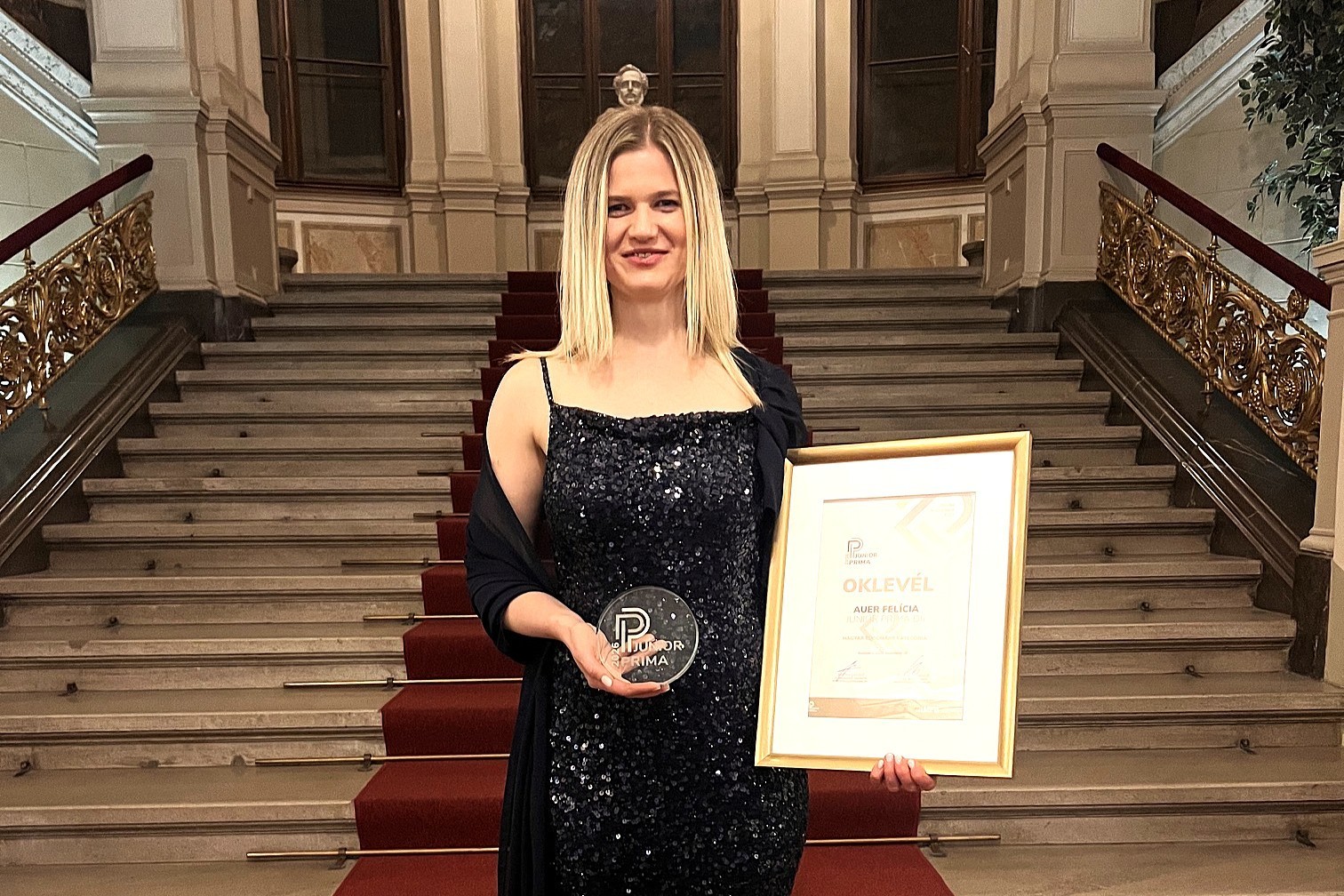
Rather than carrying out routine measurements, she wanted to explore new solutions, so after spending a year working at a water utility company, she applied for doctoral studies at the University of Pannonia. Felícia Auer, a member of the Translational Glycomics Research Group, received the Junior Prima Award in the “Hungarian Science” category on 10 November 2026 at the headquarters of the Hungarian Academy of Sciences. We spoke with her about the joy of research, her own ideas, and the people who have supported her along the way.
How did you find out that you had won the award? Who was the first person you called?
It was a Friday, and I was walking home after a workout that hadn't gone particularly well. I thought I'd quickly check my emails before the weekend, not expecting to find this particular message among them.
I started reading, and at first, I saw the usual wording about the selection committee having made its decision. I thought, well, it didn't work out this year, but I could try again next year. I would still be eligible for the under-33 category.
Then I kept reading and suddenly saw, in capital letters, that they were congratulating me and that the judges had been impressed by my application.
I completely broke down in tears. I was crying so much that two people stopped in the street, wondering what had happened and why I was so upset. They were just about to approach me when I called my mum, still crying, and said, “Mum, I won! I won!”
At that point, the passers-by simply smiled and continued on their way, reassured that everything was fine.
My mum asked, “Okay, okay, but what did you win?” So I explained what an incredible honour this award was and how significant it is to receive such recognition in Hungary. Naturally, we continued crying together. 😄
She was absolutely delighted. My parents have always encouraged and supported me in everything I've pursued. After that, I called my dad. He was working at the time, but he was also incredibly happy and proud of me.
If you were giving someone a tour of your laboratory, what would you show them first? How could the method you're developing be useful?
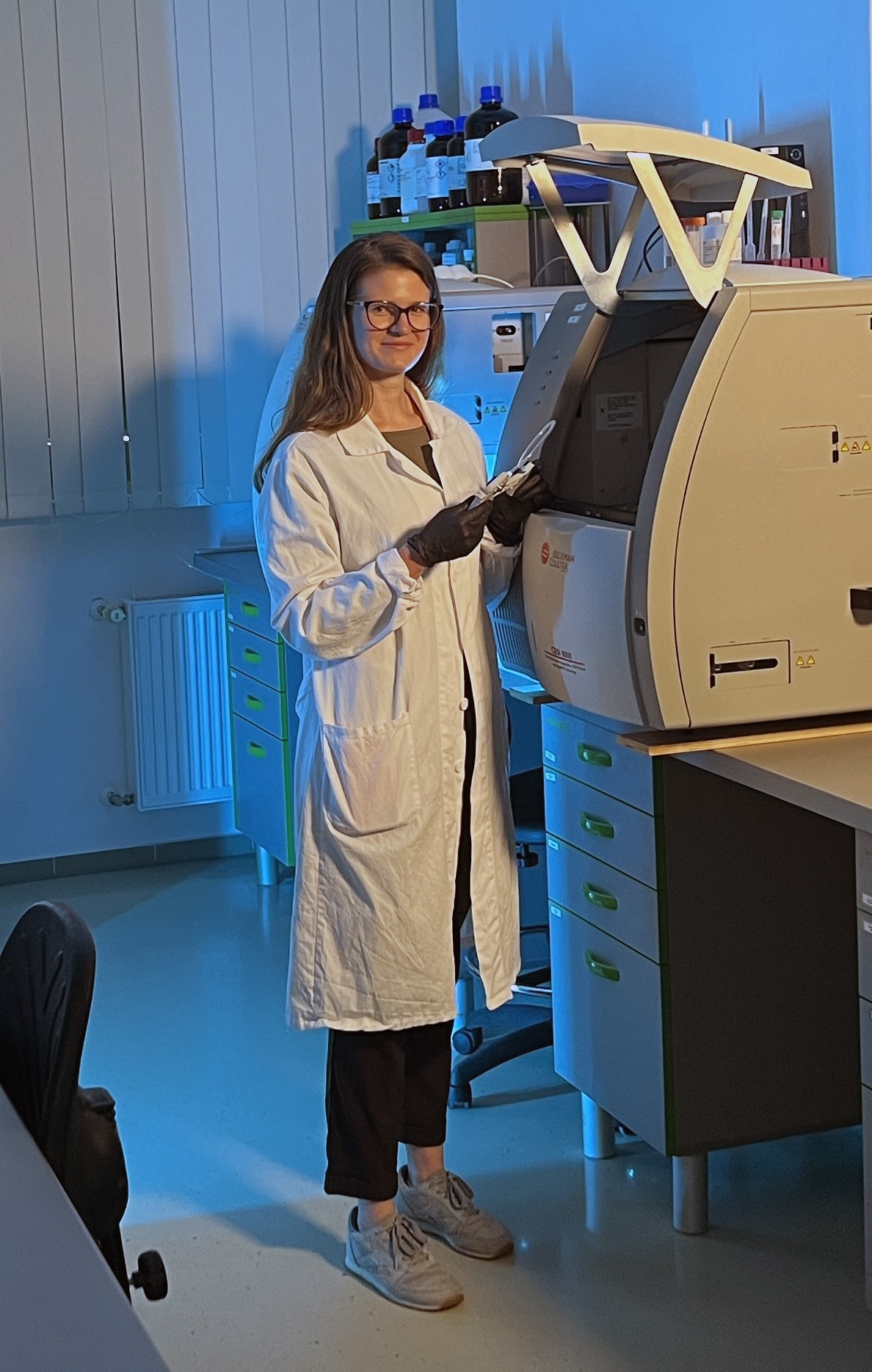
Probably the capillary we use to separate molecules. It's a glass tube as thin as a human hair, coated with a layer of polyimide to make it less fragile.
When it comes to proteins, my main goal is to find the most efficient ways to separate or detect them. Ultimately, we want to use this method to develop an analytical procedure for testing therapeutic products that is more accurate while also being faster and simpler.
Why did you decide to pursue a PhD, and what was it like to begin your research in Veszprém?
When I started my PhD studies at the University of Pannonia, I was working with human milk oligosaccharides. These samples were the subject of my very first analytical measurements.
Before that, I had worked as a master's student in a cell biology laboratory at the Department of Immunology at Eötvös Loránd University (ELTE).
Naturally, I always showed the results from the human milk samples first to my supervisor, András Guttman, as well as to Márton Szigeti and Róbert Farsang, who continuously supported my practical laboratory work.
These samples are biologically very complex. They need to be defatted, and the proteins must also be removed before the milk oligosaccharides can be properly analysed. As a beginner in analytical chemistry, I found them quite challenging.
But I was very fortunate to have such excellent professionals supporting me and helping me gain laboratory experience.
Before applying for the PhD programme, I spent a year working at a water utility company in Vas County. I actually enjoyed working there, and the team was fantastic, but somehow I felt that I needed something that would challenge me intellectually a little more.
I didn't want to spend the rest of my life doing routine analytical work. I wanted to create something.
So I started looking into research topics and came to Veszprém for an interview. It went very well, and I was admitted that same year, so I moved to Veszprém.
How did you work together with your supervisor and mentors? Was there an idea of your own that you tested together? When did their support mean the most to you?
András Guttman and I were constantly brainstorming. It was actually his idea to try a fluorescent dye for protein separation.
I have to admit that I was a little concerned at first because the chemical he suggested had toxic properties, and I wasn't particularly keen on experimenting with it over a long period.
Of course, I told him this, and he understood. But I suggested a different dye, which produced such promising results that our work eventually led to a patent application.
Gábor Járvás was my other mentor, and he also continuously supported me professionally.
I'll never forget coming home after spending two months as a visiting researcher in Seoul. I was feeling very uncertain about myself and was really struggling emotionally.
Gábor sensed this and knew that we needed to talk about it. Perhaps it's thanks to that conversation that I'm still here today. I felt that he believed in me and that we were a team.
That conversation meant an enormous amount to me.
Which opportunity had the greatest impact on you during your university years?
Perhaps my time as a visiting researcher in South Korea was the most defining experience.
Thanks to András, I had the opportunity to spend two months working at Seoul National University, where I learned a great deal.
Which of your achievements required the most work?
Definitely the work that led to the patent application.
There were countless measurements that produced results different from what we expected, but we repeated them as many times as necessary, and eventually, we developed a successful method.
What helps you when you feel less enthusiastic about your work?
Probably our research group.
The way my colleagues approach research is incredibly motivating. Whenever my own motivation starts to fade, I always draw new energy from them.
Who nominated you for the award? How did it feel to read the recommendation?
Gábor was the first to send me the call for nominations. Then Professor András Gelencsér wrote a wonderful recommendation for me, and he was ultimately the one who nominated me for the award.
I remember that he submitted my nomination in April.
I was deeply moved and read the recommendation he had written about me through tears. I had never received such a personal and appreciative recommendation from anyone before.
Even then, I already felt like a winner, because having such a highly respected expert speak so positively about my work was an enormous honour in itself.
What are you currently working on, and what research questions interest you?
I'm currently involved in several research projects running in parallel.
On the one hand, I'm continuing my work on protein separation. On the other, I'm also involved in a new project in which we aim to predict how patients with head and neck cancer will respond to radiotherapy based on the N-glycan patterns in their saliva.
In the future, this method could help predict which patients are likely to respond well to treatment and for whom it may be less effective, thereby contributing to personalised therapy.
What would you highlight about research to a student who is still unsure whether to pursue it?
Perhaps the travelling, the conferences, and the fact that I've met so many people through my work who have continuously supported and encouraged me.
There is certainly a strong competitive element in research, but I have to say that I've never felt held back or overshadowed by another researcher.
Quite the opposite: everyone always seems willing to help each other overcome difficulties and find answers to questions that arise.
It's an incredibly supportive community, which is something truly precious in today's world.
Congratulations on this outstanding achievement! We wish you continued success and many more rewarding experiences in your research career!